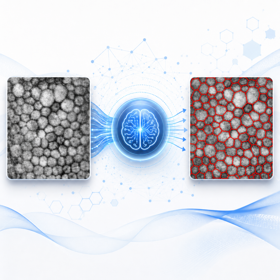
AI-based biomedical image analysis for cell segmentation
AI-based biomedical image analysis for cell segmentation
Our Challenge
Modern biomedicine increasingly depends on large collections of microscopy images, but extracting reliable, reproducible measurements from them at scale is still a bottleneck for both research and clinical decision-making. In this ECIU challenge, you will work in multidisciplinary student teams and take on a real, open biomedical image analysis problem provided by PioneerBio AB and its clinical collaborators. You will work with anonymised microscopy data, apply AI-based cell-segmentation pipelines, compare quantitative readouts across patient groups, and turn pixel-level outputs into a clear, evidence-based answer to a clinically meaningful question. The challenge is hosted on a dedicated GPU-backed JupyterHub at LiU, so no local software installation is required, but basic Python programming skills are necessary.
The Team
Teachers
These are the teachers you'll work with on the challenge.
Learners
Challenge providers
- Study period
- 19 October – 20 November 2026
- Study format
- Blended
- Application period
- 5 June – 27 September 2026
- Credits
- 5 ECTS
- Hosting university
- Linkoping University
- Topics
- Learner type
- Students
- EQF Level
Master Level
Information
Value and progress
AI models in biomedical imaging
After completing the course, the student is expected to be able to apply pre-trained deep learning models to biomedical images and integrate them into a reproducible analysis pipeline.
ESCO SKILLS
Research question formulation
After completing the course, the student is expected to be able to: formulate a quantitative biomedical research question that can be addressed using AI-based image segmentation, based on a real microscopy dataset.
ESCO SKILLS
Deep learning-based image analysis
After completing the course, the student is expected to be able to apply deep learning–based image analysis in clinical and biomedical contexts.
ESCO SKILLS
Interactive computational environments
After completing the course, the student is expected to be able to use interactive computational environments and accelerated data processing through version-controlled notebooks.
ESCO SKILLS
Measurement extraction from segmented images
After completing the course, the student is expected to be able to extract biologically and clinically relevant measures of cell density, cell area, shape, spatial organization, and hexagonality from segmented images and compare them across patient groups.
ESCO SKILLS
Cross-cultural teamwork
After completing the course, the student is expected to be able to work effectively in international and interdisciplinary teams by coordinating and communicating across different areas of expertise and roles.
ESCO SKILLS
Communication skills
After completing the course, the student is expected to be able to communicate methods, results, and limitations of an AI-based image analysis solution to a clinically oriented audience, both in writing and orally.
ESCO SKILLS
Evaluation
After completing the course, the student is expected to be able to critically evaluate segmentation quality through qualitative inspection as well as quantitative comparison with reference annotations.
ESCO SKILLS
Assessment
After completing the course, the student is expected to be able to assess the reliability of comparisons between patient groups using appropriate statistical methods
ESCO SKILLS
Ethics
After completing the course, the student is expected to be able to reflect on ethical aspects of AI-based clinical image analysis.
ESCO SKILLS
Not sure which competencies suit you?
Take our motivation scan to find learning opportunities that will help you reach your potential goal and growth.