MOBISEN
MOBISEN
Description
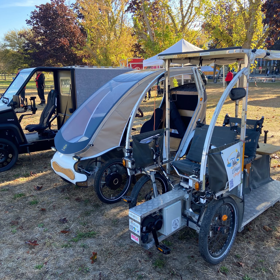
Particularly in sparsely populated areas (rural or peri-urban), older people remain heavily reliant on private cars for their daily journeys (healthcare, shopping, administrative tasks, access to public transport). This dependence ultimately leads to a well-recognised problem: giving up driving is strongly linked to a loss of independence, social isolation and adverse effects on older people’s health. However, credible alternatives to the car remain limited outside major urban areas. The project aims to identify the factors influencing the adoption, acceptability and sustained use of low-carbon mobility options amongst older people, particularly those living in rural or peri-urban areas, through surveys to be designed, carried out and analysed. The need for digital tools and services required to change mobility patterns will also be assessed. The surveys will enable the subsequent promotion of active mobility options that promote health, preserve independence and fight a sedentary lifestyle. These modes of transport will be compared with practices reliant on private cars or taxis in order to quantify the number of kilometres driven (and tonnes of CO₂) avoided, the rates and types of use of low-carbon transport services, and the conditions under which the experiments conducted and results obtained can be transferred to other regions in France and Europe. The aim of the challenge is to learn how to carry out a needs analysis in order to develop a product or service and to familiarise oneself with low-carbon modes of transport.
The Team
Teachers
Meet the expert teaching staff, who is here to guide you through this learning opportunity.
Learners
- Study period
- 1 March – 31 May 2027
- Study format
- Blended
- Application period
- 26 November 2026 – 14 February 2027
- Credits
- 3 ECTS
- Hosting university
- INSA Group
- Learner type
- AlumniStudents
- EQF Level
Master Level
Information
Value and progress
Conceive, carry out and analyse surveys
By the end of this micro-module, you will be able to design and conduct surveys to identify mobility needs and preferences, analyse the collected data, identify trends and draw conclusions to inform the development of sustainable mobility solutions.
ESCO SKILLS
Conceive new concepts of active mobility
By the end of this micro-module, you will be able to propose innovative, low-carbon mobility solutions and explore ways to improve existing mobility services and programmes, taking into account their effectiveness, sustainability and accessibility.
ESCO SKILLS
Conceive specific conceptsfor elderly people in semi-urban and rural areas
By the end of this micro-module, you will be able to develop mobility solutions adapted to the specific needs of older people living in rural and peri-urban areas, considering accessibility, independence, health and potential mobility limitations.
ESCO SKILLS
Collaborate and communicate in international teams
By the end of this micro-module, you will be able to collaborate effectively in an interdisciplinary and international team, combine different fields of knowledge, and present your methodology and key results clearly in a foreign language.
ESCO SKILLS
Not sure which competencies suit you?
Take our motivation scan to find learning opportunities that will help you reach your potential goal and growth.
Hosting university
INSA Group