
Back to the Future: energy security and Microalgae
Back to the Future: energy security and Microalgae
Our Challenge
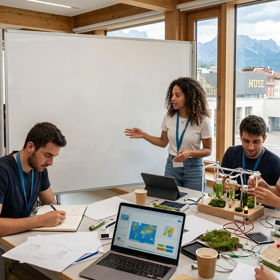
This edition of Back to the Future invites learners to explore energy security in a time of volatile fuel prices, climate disruption, and deepening inequalities. Working in multidisciplinary, international teams, students will collaborate with SEADS (Space Ecologies Art and Design), to imagine more just and resilient energy futures. Using tools inspired by futures such as adaptations of scenarios and back‑casting, participants will investigate how changing desires, habits, and cultural imaginaries shape energy demand, as well as where future energy might come from: from microalgae and circular bio-resources to human-scale and distributed systems. Throughout the week in Trento and in complementary online activities, students will prototype concepts and recommendations that are technologically plausible, socially grounded, and ethically informed. The challenge aims to cultivate critical and imaginative capacities to rethink energy beyond extraction and scarcity, towards sufficiency, solidarity, and more-than-human sustainability.
The Team
Teachers
These are the teachers you'll work with on the challenge.
Learners
Challenge providers

- Study period
- 12 November – 18 December 2026
- Study format
- Blended
- Application period
- 8 July – 7 September 2026
- Credits
- 3 ECTS
- Hosting university
- University of Trento
- Topics
- -
- Learner type
- Students
- EQF Level
Bachelor Level
Information
Value and progress
Analyse energy consumption
Evaluate and analyse the total amount of energy used by a company or an institution by assessing the needs linked to the operative processes and by identifying the causes of superfluous consumption.
ESCO SKILLS
Deal with uncertainty
Tolerate and work constructively within unexpected and unpredictable situations.
ESCO SKILLS
Designing systems and products
Creating a plan or specification for the construction of an object, system or structure based on aesthetic and/or functional design concepts.
ESCO SKILLS
Energy
Power capacity in the form of mechanical, electrical, heat, potential, or other energy from chemical or physical resources, which can be used to drive a physical system.
ESCO SKILLS
Energy efficiency
Field of information concerning the reduction of the use of energy. It encompasses calculating the consumption of energy, providing certificates and support measures, saving energy by reducing the demand, encouraging efficient use of fossil fuels, and promoting the use of renewable energy.
ESCO SKILLS
Energy storage systems
The systems to capture the energy produced at one time for use at a later time. This includes the differences between the main battery types, super capacitors and hydrogen or fuel tanks.
ESCO SKILLS
Innovation processes
The techniques, models, methods and strategies which contribute to the promotion of steps towards innovation.
ESCO SKILLS
Thinking creatively and innovatively
Generate new ideas or combine existing ones to develop innovative, novel solutions.
ESCO SKILLS
Think critically
Make and defend judgements based on internal evidence and external criteria. Critically evaluate the credibility and reliability of information before using or passing it on to others. Develop independent and critical thinking.
ESCO SKILLS
Not sure which competencies suit you?
Take our motivation scan to find learning opportunities that will help you reach your potential goal and growth.
Hosting university
University of Trento

Challenge provider