
Resilience of Lithuanian Railways to climate change-related risks
Resilience of Lithuanian Railways to climate change-related risks
Our Challenge
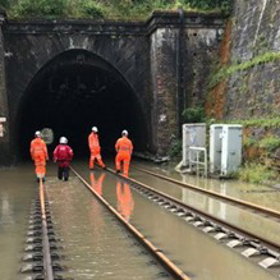
This challenge invites students to explore how projected climate change and weather phenomena, such as increasing heavy rainfall, heatwaves, cold cycles, geological changes, and others, may affect Lithuania’s railway infrastructure assets, their operation, and maintenance. Your task is to identify the most climate-vulnerable locations in Lithuania’s railway infrastructure and develop practical, economically and technically sound measures that would help prepare for future climate scenarios and minimize or avoid negative impacts on railway operations. During the challenge, participants will: • identify methods for determining railway infrastructure locations vulnerable to climate-related impacts, based on meteorological and topological factors such as precipitation, temperature, soil, terrain, water bodies, etc.; • assess the projected impact of climate change on infrastructure, operations, and maintenance; • evaluate significant risks and propose practical, economically and technically sound solutions, such as improved drainage, increased rail resilience, monitoring systems, climate risk management models, or other adaptation measures; • where possible, conduct a cost–benefit analysis assessing the investments required for climate resilience measures and the value they generate. Participants are encouraged to assess global climate trends as well as climate change models specific to Lithuania, EU and national targets, and international best practices. Based on this analysis, they will develop concrete measures ranging from infrastructure and rolling stock to maintenance processes and operational planning. By participating in the challenge, students will develop analytical, systems-thinking, and sustainability competencies, work with real data, and contribute to solutions with a long-term impact on the resilience of national infrastructure to climate change.
The Team
Teachers
These are the teachers you'll work with on the challenge.
Learners
Challenge providers

- Study period
- 8 October – 17 December 2026
- Study format
- Online
- Application period
- 29 June – 26 September 2026
- Credits
- 6 ECTS
- Hosting university
- Kaunas University of Technology
- Topics
- Learner type
- Students
- EQF Level
Master Level
Information
Value and progress
Create and present ideas and prototypes
Create and effectively present innovative ideas and developed prototypes tailored to the requirements of unique audience.
ESCO SKILLS
Tackle real-world issues
Innovatively tackle complex real-world issues using the core tenets of challenge-based learning methodology.
ESCO SKILLS
Pinpoint research direction
Self-sufficiently pinpoint a unique and impactful research direction, utilizing existing knowledge and acquired competencies.
ESCO SKILLS
Utilise teamwork and leadership principles
Utilise effective teamwork and leadership principles while collaborating within diverse, interdisciplinary teams.
ESCO SKILLS
Not sure which competencies suit you?
Take our motivation scan to find learning opportunities that will help you reach your potential goal and growth.
Hosting university
Kaunas University of Technology

Challenge provider