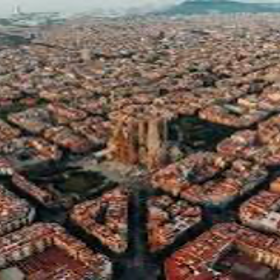
Ageing Well: Rethinking Housing in Barcelona
Ageing Well: Rethinking Housing in Barcelona
Our Challenge
Population ageing is reshaping housing needs across European cities, and Barcelona shows this clearly. At the start of 2026, 21.1% of the city's 1.73 million residents were aged 65 or over, and 18.6% of them were 85 or older. In some neighbourhoods, such as Canyelles, Vall d'Hebron and Les Corts, the share of older residents approaches or exceeds 30%. Nearly a third of households are one-person households, and living alone is especially common after 65. Why is this important? Many older people want to stay in their homes and neighbourhoods, but accessibility barriers, rising costs, poor building conditions and changing care needs can make this difficult. Without suitable alternatives, they may have to choose between an inadequate home and leaving the community that supports them. Housing policy for an ageing city is therefore about more than dwellings: it also concerns autonomy, care and social connection. Possible responses include adapting existing homes, accessible and affordable housing, public housing for older people, and cooperative or cohousing models that combine private space with shared facilities and mutual support. How can you help? Barcelona City Council is the stakeholder for this challenge. Working in interdisciplinary teams, students will develop an evidence-based proposal that identifies a concrete ageing-related housing problem, assesses existing instruments, and compares conventional public intervention with cooperative or cohousing solutions. Recommendations must be legally and institutionally feasible, affordable and accessible, and must strengthen older residents' autonomy and community ties. During the mobility week in Barcelona, students will visit housing initiatives such as Can 70 in Sarrià, a pioneering senior cooperative-housing project developed by Sostre Cívic on municipal land.
The Team
Teachers
These are the teachers you'll work with on the challenge.
Learners
Challenge providers
- Study period
- 13 October – 18 December 2026
- Study format
- Blended
- Application period
- 17 September – 4 October 2026
- Credits
- 3 ECTS
- Hosting university
- Universitat Autònoma de Barcelona
- Topics
- Learner type
- Students
- EQF Level
Bachelor Level
Information
Value and progress
Action-Research Design
By the end of the challenge, the learner can design and carry out collaborative inquiry with public and community stakeholders, combining documentary analysis with fieldwork.
ESCO SKILLS
Collaborative and Interdisciplinary Work
By the end of the challenge, the learner can work effectively in an international team and integrate perspectives from different academic backgrounds into a shared proposal.
ESCO SKILLS
Housing and Ageing Analysis
By the end of the challenge, the learner can analyse how demographic ageing affects housing needs, independent living, accessibility and social inclusion in urban settings.
ESCO SKILLS
Local Policy Design for Ageing in Place
By the end of the challenge, the learner can assess the scope of local action and formulate feasible housing and urban-policy measures that support ageing in place.
ESCO SKILLS
Innovative Housing Responses
By the end of the challenge, the learner can compare alternative housing approaches for later life, including cooperative housing in grant-of-use, senior cohousing and other community-based models, and translate relevant lessons into a proposal for Barcelona.
ESCO SKILLS
Not sure which competencies suit you?
Take our motivation scan to find learning opportunities that will help you reach your potential goal and growth.